

A hypergram, introduced by Muller and Giorgetti (2025), is a triple  in which
  is a finite hypergraph
without isolated vertices or empty hyperedges and
is a finite hypergraph
without isolated vertices or empty hyperedges and  is a reduced simple
graph on
is a reduced simple
graph on  .
Here, reduced means that
.
Here, reduced means that  has no isolated vertices or distinct vertices
with identical neighborhoods. It is also required
that
has no isolated vertices or distinct vertices
with identical neighborhoods. It is also required
that
 |
(1)
|
where two distinct vertices are adjacent in  when they do not share a hyperedge
of
when they do not share a hyperedge
of  (Muller and Giorgetti 2025).
In the application to observable-based proofs of the Kochen-Specker theorem, the vertices represent nonidentity elements of an  -qubit Pauli
group, the hyperedges represent contexts of mutually
commuting observables whose products are
-qubit Pauli
group, the hyperedges represent contexts of mutually
commuting observables whose products are  or
or  ,
and adjacency in
,
and adjacency in  represents anticommutation. An
  -qubit Pauli assignment is an injective
map from
-qubit Pauli assignment is an injective
map from  to the nonidentity Pauli observables that has exactly these commutation and context-product
relations.
to the nonidentity Pauli observables that has exactly these commutation and context-product
relations.
Let  be the incidence
matrix of
be the incidence
matrix of  ,
with rows indexed by vertices and columns by hyperedges,
and let
,
with rows indexed by vertices and columns by hyperedges,
and let  be the adjacency matrix of
  . Regard both as matrices over the finite
field
. Regard both as matrices over the finite
field  .
A hypergram has a Pauli assignment iff
.
A hypergram has a Pauli assignment iff
 |
(2)
|
Equivalently, every hyperedge contains an even number of neighbors of each vertex. When these conditions hold, an assignment can be constructed in cubic time and the required number of qubits is
 |
(3)
|
where  denotes matrix
rank (Muller and Giorgetti 2025).
denotes matrix
rank (Muller and Giorgetti 2025).
Muller and Saniga (2026) define the hypergraph support  of a reduced simple
graph
of a reduced simple
graph  to consist of the nonempty independent sets
  for which
 |
(4)
|
where  is the incidence vector of
  . Every valid context family
  of a hypergram with anticommutation graph
  satisfies
  .
.
Each Pauli assignment gives every context  a quantum sign
  according as its observable product is
  . A classical assignment
  instead gives the sign
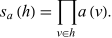 |
(5)
|
The contextuality degree is the minimum Hamming distance
 |
(6)
|
It is positive exactly when the assignment is contextual. The associated noncontextual bound and tolerated error per context are
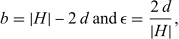 |
(7)
|
respectively. These quantities depend only on the hypergram and not on the particular Pauli assignment (Muller and Giorgetti 2025).
Earlier work computed contextuality degrees for families of configurations in binary symplectic polar spaces (de Boutray et al. 2022) and tight noncontextual bounds for magic sets of observables (Trandafir, Lisonek, and Cabello 2022).
If  is the line
graph of a simple graph
is the line
graph of a simple graph  , every perfect matching
of
, every perfect matching
of  is a context in
  (Muller and Saniga 2026). Indeed, a perfect
matching is an independent set in
(Muller and Saniga 2026). Indeed, a perfect
matching is an independent set in  , while each vertex outside it has exactly two neighbors
in it. This supplies many contexts for line graphs.
In particular,
, while each vertex outside it has exactly two neighbors
in it. This supplies many contexts for line graphs.
In particular,  gives the rook graph family beginning with the Peres-Mermin
square, and
gives the rook graph family beginning with the Peres-Mermin
square, and  gives the triangular graph family beginning with
the doily configuration, namely the generalized
quadrangle
gives the triangular graph family beginning with
the doily configuration, namely the generalized
quadrangle  .
.
Under the assumptions that all contexts have the same size and every observable belongs to two contexts, the Peres-Mermin square and Mermin pentagram are the smallest observable-based proofs (Holweck and Saniga 2017).
Some exact contextuality values reported by Muller and Saniga (2026) are summarized below. The last row is a disjoint union of three copies of the Petersen graph; it is not a connected configuration.
| anticommutation graph | configuration |  |  |  |  |
 | Peres-Mermin square | 9 | 6 | 1 |  |
Petersen
graph  | Mermin pentagram | 10 | 5 | 1 |  |
 | doily | 15 | 15 | 3 |  |
 | connected configuration | 25 | 120 | 36 |  |
 | three Mermin pentagrams | 30 | 215 | 76 |  |
The value  in the last row was the largest exact value found in that search. The larger values
listed there for
in the last row was the largest exact value found in that search. The larger values
listed there for  and
and  are only heuristic upper bounds
on
are only heuristic upper bounds
on  , not certified contextuality degrees.

 -Qubit Systems." Phys. Rev. Lett. 129, 200401,
2022.
-Qubit Systems." Phys. Rev. Lett. 129, 200401,
2022.