

The Humbert functions are seven confluent hypergeometric functions of two variables obtained as limits of the
Appell hypergeometric functions.
They are conventionally denoted  ,
,  ,
,  ,
,  ,
,  ,
,  , and
, and  , and have defining series
 |  | 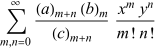 |
(1)
|
 |  | 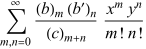 |
(2)
|
 |  | 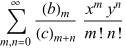 |
(3)
|
 |  | 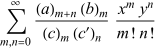 |
(4)
|
 |  | 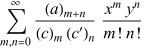 |
(5)
|
 |  | 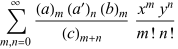 |
(6)
|
 |  | 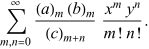 |
(7)
|
Here  is the Pochhammer symbol, and no denominator
parameter is a nonpositive
integer. The double series for
is the Pochhammer symbol, and no denominator
parameter is a nonpositive
integer. The double series for  ,
,  ,
,  , and
, and  converge for
  and finite
  , while those for
  ,
,  , and
, and  converge for all finite
  and
and  . Setting one variable to zero gives a hypergeometric
function or a confluent
hypergeometric function of the first kind.
. Setting one variable to zero gives a hypergeometric
function or a confluent
hypergeometric function of the first kind.
The function  is the two-variable case of a confluent form of the Lauricella
functions, and it occurs in a finite representation of the Erdélyi
multivariate Laguerre polynomials (Erdélyi 1937, Guo et al. 2026).
is the two-variable case of a confluent form of the Lauricella
functions, and it occurs in a finite representation of the Erdélyi
multivariate Laguerre polynomials (Erdélyi 1937, Guo et al. 2026).
