TOPICS
Search

Hopfield Model


The Hopfield model is a binary spin model whose interaction strengths are constructed from stored patterns (Hopfield 1982, Amit et al. 1985). In its statistical-mechanical form, the configurations are sigma in {-1,1}^N, and the columns of an N×M_N matrix X_N are the stored patterns. A convention for the energy that retains the diagonal terms is
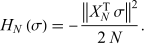
 H_N(sigma)=-(||X_N^Tsigma||^2)/(2N).

At inverse temperature beta, the Gibbs measure assigns weights proportional to e^(-betaH_N(sigma)). The free energy in the convention of Ali et al. (2026) is the natural logarithm of the statistical-mechanical partition function per spin with the uniform measure as reference,

 F_N(beta)=1/NlnE_sigma[e^(-betaH_N(sigma))],

where E_sigma is the expectation value for uniform sigma at fixed X_N.

For independent entries of X_N taking each of +/-1 with probability 1/2 and M_N/N->alpha in (0,infty), Ali et al. (2026) report a deterministic variational limit of F_N(beta) for every beta>0. The stated convergence is almost sure and in L^1 with respect to the patterns. Ali reports GPT-6 Astra assistance with the existence proof. The authors report checking the proofs by hand.


See also

Gibbs Measure, Spin Glass, Statistical-Mechanical Partition Function

Explore with Wolfram|Alpha

References

Ali, A.; Boursier, J.; Chen, H.-B.; Ho, F.-H.; Issa, V.; and Mourrat, J.-C. "Free Energy of the Hopfield Model." 2 Nov 2026. https://arxiv.org/abs/2611.03306v1.Amit, D. J.; Gutfreund, H.; and Sompolinsky, H. "Spin-Glass Models of Neural Networks." Phys. Rev. A 32, 1007-1018, 1985. https://doi.org/10.1103/PhysRevA.32.1007.Hopfield, J. J. "Neural Networks and Physical Systems with Emergent Collective Computational Abilities." Proc. Natl. Acad. Sci. USA 79, 2554-2558, 1982. https://doi.org/10.1073/pnas.79.8.2554.

Cite this as:

Weisstein, Eric W. "Hopfield Model." From MathWorld--A Wolfram Resource. https://mathworld.wolfram.com/HopfieldModel.html

Subject classifications
