

A homotopy type is a class formed by sets in  which have essentially the same structure, regardless of
size, shape and dimension. The "essential structure" is what a set keeps
when it is transformed by compressing or dilating its parts, but without cutting
or gluing. The most important feature that is preserved is the system of internal
closed paths. In particular, the fundamental group
remains unchanged. This object, however, only characterizes the loops, i.e., the
paths which are essentially circular lines, whereas the homotopy type also refers
to higher dimensional closed paths, which correspond to the boundaries of
which have essentially the same structure, regardless of
size, shape and dimension. The "essential structure" is what a set keeps
when it is transformed by compressing or dilating its parts, but without cutting
or gluing. The most important feature that is preserved is the system of internal
closed paths. In particular, the fundamental group
remains unchanged. This object, however, only characterizes the loops, i.e., the
paths which are essentially circular lines, whereas the homotopy type also refers
to higher dimensional closed paths, which correspond to the boundaries of  -spheres. Hence the homotopy type yields a more precise classification
of geometric objects. As for the circular paths, it makes no difference whether the
object is located in the plane or on the surface of a sphere, so the fundamental
group is the same in both cases.
-spheres. Hence the homotopy type yields a more precise classification
of geometric objects. As for the circular paths, it makes no difference whether the
object is located in the plane or on the surface of a sphere, so the fundamental
group is the same in both cases.
The homotopy type, however, is different, since the plane does not contain any spherical path. In general, two closed paths in a set are compared by verifying if they can be reduced to the same geometric object in the set. A circular path on a surface can be reduced to any given point of the same surface by first contracting it to its center and the moving the center to the given point. The same is true for a spherical path in a solid. All closed paths in a square and in a cube are of the same kind as a point, hence a cube, a square and a point are of the same homotopy type.
In more general cases, however, holes and gaps can be obstructions to the transformations described above. A hollow sphere can be contracted to a spherical surface, but there
is no way to reduce it further. The case of the cube, the square and the point shows
that a homotopy type can include sets of different dimensions: hence its elements
are not all homeomorphic, but are related in a more general way. According to the
formal definition, two sets  and
and  are of the same homotopy type if one can find two continuous
maps
are of the same homotopy type if one can find two continuous
maps  and
and  such that the map compositions
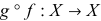 and
and  not necessarily are equal to the identity
maps on
not necessarily are equal to the identity
maps on  and
and  respectively, but are homotopic to them, i.e., they can be reduced to them by continuous
deformations.
respectively, but are homotopic to them, i.e., they can be reduced to them by continuous
deformations.
