The Hölder-regularized sum of order series is obtained by repeatedly
averaging its partial sums . If
(1)
for series is Hölder-summable of order
For each positive integer Cesàro
summability of order sequences
are different (Hardy 1949, p. 103). Ordinary convergence
is the order-zero case.
For example, let divergent
series partial sums are
(2)
Thus, the even and odd subsequences tend to
(3)
where floor function and harmonic number .
Since sequence series is Hölder-summable
of order 2 but not of order 1 (Hardy 1949, p. 94).
See also Abel-Regularized Sum ,
Cesàro Sum ,
Divergent
Series ,
Partial Sum ,
Regularized
Sum
Explore with Wolfram|Alpha
References Boos, J. Classical and Modern Methods in Summability. https://doi.org/10.1093/oso/9780198501657.001.0001 . Ford,
W. B. "On the Relation Between the Sum-Formulas of Hölder and Cesàro."
Amer. J. Math. 32 , 315-326, 1910. https://doi.org/10.2307/2370184 . Ford,
W. B. Studies
on Divergent Series and Summability and the Asymptotic Developments of Functions
Defined by Maclaurin Series. Hardy,
G. H. Divergent
Series. Trott, M. "Sums."
§1.6.6 in The
Mathematica GuideBook for Symbolics. https://doi.org/10.1007/0-387-28815-5 .
https://www.mathematicaguidebooks.org/ . Tucciarone,
J. "The Development of the Theory of Summable Divergent Series from 1880 to
1925." Arch. Hist. Exact Sci. 10 , 1-40, 1973. https://doi.org/10.1007/BF00343405 .
Cite this as:
Weisstein, Eric W. "Hölder-Regularized
Sum." From MathWorld https://mathworld.wolfram.com/Hoelder-RegularizedSum.html
Subject classifications


 of a series is obtained by repeatedly
averaging its partial sums. If
 , define
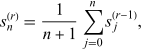
 ,
...,
 .
The series is Hölder-summable of order
 to
 if
 .
 , Hölder summability of order
 , denoted
 , is equivalent to Cesàro
summability of order
 , although the intermediate transformed sequences
are different (Hardy 1949, p. 103). Ordinary convergence
is the order-zero case.
 , giving the divergent
series
 .
The partial sums are
 and
 . Their first averages are

 and 0, respectively. A second averaging gives

 uses the floor function and
 is a harmonic number.
Since
 ,
the sequence
 tends to
 , so the series is Hölder-summable
of order 2 but not of order 1 (Hardy 1949, p. 94).
