

A group corepresentation of a group  with a distinguished subgroup
  of index two
is a homomorphism from
of index two
is a homomorphism from  to invertible semilinear
maps of a complex vector space
to invertible semilinear
maps of a complex vector space  such that elements of
  act by linear transformations
and elements of the other coset act by conjugate-linear
transformations. For any
act by linear transformations
and elements of the other coset act by conjugate-linear
transformations. For any  ,
,
 |
(1)
|
Thus, after choosing a basis and writing  for the componentwise complex
conjugate operation, a corepresentation has the form
for the componentwise complex
conjugate operation, a corepresentation has the form
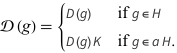 |
(2)
|
where the matrices  obey the multiplication rules imposed by
  . If every element acts by a linear
transformation, the definition reduces to an ordinary group
representation.
. If every element acts by a linear
transformation, the definition reduces to an ordinary group
representation.
Corepresentations were introduced by Wigner (1959) to treat symmetries containing antiunitary operations. In quantum mechanics, time reversal is represented by an antiunitary operation. A magnetic group containing time reversal therefore includes ordinary spatial symmetries together with symmetries composed with this antiunitary operation, and a corepresentation describes their combined linear and conjugate-linear action (Bradley and Cracknell 2009).
