

The graphical arrangement of a simple graph  on the vertex
set
on the vertex
set ![[l]={1,...,l}](/images/equations/GraphicalArrangement/Inline2.svg) is the hyperplane arrangement in
is the hyperplane arrangement in  given by
 |
(1)
|
Thus every subarrangement of the braid arrangement is graphical. The complete graph  gives the full braid arrangement, while the empty graph
gives the empty arrangement.
gives the full braid arrangement, while the empty graph
gives the empty arrangement.
The arrangement characteristic polynomial equals the chromatic polynomial of the graph,
 |
(2)
|
For example, a tree  on
on  vertices has
  .
.
Nian et al. (2026) associate a finite-field arrangement  with
with  . Let
. Let  be a prime power, let
  be the finite
field of order
be the finite
field of order  , and let
  be the collection of nonempty cliques
of
be the collection of nonempty cliques
of  .
Then
.
Then
 |
(3)
|
Coefficient vectors differing by a nonzero scalar define the same hyperplane. For every nonnegative integer  , its characteristic
polynomial satisfies
, its characteristic
polynomial satisfies
 |
(4)
|
Consequently, if  ,
the characteristic polynomial of
,
the characteristic polynomial of  determines the chromatic
polynomial of
determines the chromatic
polynomial of  .
.
A hyperplane arrangement is called a free arrangement when its module of logarithmic
polynomial vector fields is a free module. The graph
 is a chordal graph iff both
 and
and  are free arrangements. Suppose
  is a perfect elimination ordering, meaning that
the earlier neighbors of each
is a perfect elimination ordering, meaning that
the earlier neighbors of each  form a clique, and let
  be the number of those neighbors. Then
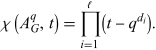 |
(5)
|
In particular, for a path graph  , this is
  .
.

 -Deformation of Chromatic Polynomials
and Graphical Arrangements." Elec. J. Combin. 33, P3.63, 2026.
-Deformation of Chromatic Polynomials
and Graphical Arrangements." Elec. J. Combin. 33, P3.63, 2026.