The graph intersection number , also called the edge clique cover number, clique edge
cover number, -content,
or (confusingly) clique cover number, of a given graph
is the smallest size of a set for which is the intersection graph
of a family of subsets of , where repeated subsets and the empty set are allowed. Equivalently,
it is the minimum number of cliques needed to cover all
of the edges of (i.e., whose edges form an edge
cover of ).
As a result of this definition, only maximal cliques
need be considered.
For a graph with vertices and edges, iff is triangle-free (Harary
1994, p. 19).
Under the convention used here, the complete graph
is itself a one-clique edge cover, so
(4)
for .
If the representing subsets are instead required to be distinct, a different parameter
is obtained; for , its value is
(5)
This distinction accounts for the larger value given by Choudamand and Parthasarathy (1975), Thomas (2004, p. 28), and Jinnah and Mathew (2017) in connection with Harary's distinct-set formulation (Harary 1994, problem 2.26, p. 25).
Choudamand, S. A. and Parthasarathy, K. R. "On the Intersection Number of Some Graphs." Proc. Indian Nat. Sci. Acad.41,
Part A, No. 3, 307-317, 1975.Erdős, P.; Goodman, A. W.;
and Pósa, L. "The Representation of a Graph by Set Intersections."
Canad. J. Math.18, 106-112, 1966. https://doi.org/10.4153/CJM-1966-014-3.Gross,
J. T. and Yellen, J. Graph
Theory and Its Applications, 2nd ed. Boca Raton, FL: CRC Press, p. 440,
2006.Harary, F. Graph
Theory. Reading, MA: Addison-Wesley, pp. 19-20, 1994.Harary,
F. and Palmer, E. M. Graphical
Enumeration. New York: Academic Press, p. 225, 1973a.Harary,
F. and Palmer, E. M. "A Survey of Graphical Enumeration Problems."
In A Survey of Combinatorial Theory (Ed. J. N. Srivastava). Amsterdam,
Netherlands: North-Holland, pp. 259-275, 1973b.Jinnah, M. I.
and Mathew, S. C. "Intersection Number of Some Comaximal Graphs."
Palestine J. Math.6, 458-464, 2017.Roberts, F. S.
"Applications of Edge Coverings by Cliques." Disc. Appl. Math.10,
93-109, 1985.Sloane, N. J. A. Sequences A355754
and A355755 in "The On-Line Encyclopedia
of Integer Sequences."Thomas, C. "A Study of Some Problems
in Algebraic Graph Theory--Graphs Arising from Rings." PhD thesis. Thiruvananthapuram,
India: University of Kerala, March 2004.


 , also called the edge clique cover number, clique edge
cover number,
, also called the edge clique cover number, clique edge
cover number,  -content,
or (confusingly) clique cover number, of a given graph
-content,
or (confusingly) clique cover number, of a given graph  is the smallest size of a set
  for which
  is the intersection graph
of a family of subsets of
is the intersection graph
of a family of subsets of  , where repeated subsets and the empty set are allowed. Equivalently,
it is the minimum number of cliques needed to cover all
of the edges of
, where repeated subsets and the empty set are allowed. Equivalently,
it is the minimum number of cliques needed to cover all
of the edges of  (i.e., whose edges form an edge
cover of
(i.e., whose edges form an edge
cover of  ).
As a result of this definition, only maximal cliques
need be considered.
).
As a result of this definition, only maximal cliques
need be considered.
 with vertex count
  and edge count
  satisfies

 ,
1, ...,
,
1, ...,  for
for  ,
2, ..., is given by
,
2, ..., is given by
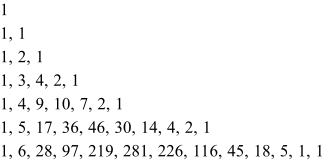
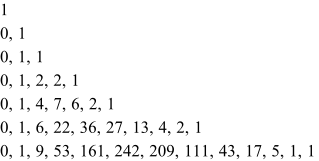
 vertices and
  edges,
  iff
iff  is triangle-free (Harary
1994, p. 19).
is triangle-free (Harary
1994, p. 19).
 is itself a one-clique edge cover, so

 .
If the representing subsets are instead required to be distinct, a different parameter
is obtained; for
.
If the representing subsets are instead required to be distinct, a different parameter
is obtained; for  , its value is
![[1+log_2n].](/images/equations/GraphIntersectionNumber/NumberedEquation5.svg)
