

Graph entropy is a collective name for several entropy-like quantities attached to a graph. Two important but distinct constructions are Körner graph entropy, which arose in information theory, and structural graph entropies obtained from partitions of graph elements (Dehmer and Mowshowitz 2011).
For a finite graph  with vertex set
  and a probability distribution
 , let
, let  be the vertex-packing polytope: the convex
hull of the 0-1 vectors of the independent
vertex sets of
be the vertex-packing polytope: the convex
hull of the 0-1 vectors of the independent
vertex sets of  .
An equivalent finite-dimensional definition of Körner graph entropy is
.
An equivalent finite-dimensional definition of Körner graph entropy is
 |
A term with  is taken to be 0, while a vector with
  and
and  makes the objective
function infinite (Csiszár et al. 1990, Simonyi 1995). Operationally,
graph edges specify pairs of source symbols that must
be distinguished, and
makes the objective
function infinite (Csiszár et al. 1990, Simonyi 1995). Operationally,
graph edges specify pairs of source symbols that must
be distinguished, and  is the optimal asymptotic coding rate in bits per symbol
(Körner 1973, Simonyi 1995).
is the optimal asymptotic coding rate in bits per symbol
(Körner 1973, Simonyi 1995).
For the empty graph  ,
, 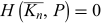 , while for the complete
graph
, while for the complete
graph  ,
,
 is the Shannon
entropy
is the Shannon
entropy 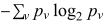 .
Maximizing over
.
Maximizing over  gives
gives  ,
where
,
where  is the fractional chromatic number
(Simonyi 1995). Körner graph entropy is distinct from the Shannon
capacity of a graph, although both arose in zero-error
information theory.
is the fractional chromatic number
(Simonyi 1995). Körner graph entropy is distinct from the Shannon
capacity of a graph, although both arose in zero-error
information theory.
A common structural construction starts with a finite set  associated with a graph
and an equivalence rule
associated with a graph
and an equivalence rule  that partitions it into equivalence classes
  . Its partition entropy is
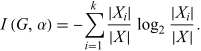 |
For example,  may be the vertex set and the equivalence
classes may be the orbits of the automorphism
group; this gives a classical measure of structural information content (Mowshowitz
1968, Dehmer and Mowshowitz 2011). If the graph represents
a molecule,
may be the vertex set and the equivalence
classes may be the orbits of the automorphism
group; this gives a classical measure of structural information content (Mowshowitz
1968, Dehmer and Mowshowitz 2011). If the graph represents
a molecule,  may instead consist of graph vertices, graph
edges, or selected fragments, with equivalence
classes determined by chemistry. The resulting quantities describe how a molecule's
atoms and bonds are arranged (Sabirov and Shepelevich 2021).
may instead consist of graph vertices, graph
edges, or selected fragments, with equivalence
classes determined by chemistry. The resulting quantities describe how a molecule's
atoms and bonds are arranged (Sabirov and Shepelevich 2021).
Many other definitions apply Shannon entropy to distributions derived from vertex degrees, graph distances, graph spectra, or other graph data. In particular, applying von Neumann entropy to a suitably normalized Laplacian matrix gives a spectral graph entropy. Consequently, the phrase "graph entropy" should be accompanied by the definition in use (Dehmer and Mowshowitz 2011).
In the Season 4 episode "Black Swan" of the television crime drama NUMB3RS, the character Amita Ramanujan refers to graph entropies while studying a map of Los Angeles.
