Graham's biggest little hexagon is the largest possible (not necessarily regular) convex hexagon with polygon
diameter 1 (i.e., for which no two of the vertices
are more than unit distance apart). It is therefore
the biggest little polygon for the case
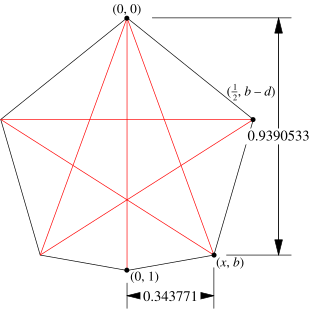
. The solution is given by the above figure (which
is shown with incorrect proportions in Conway and Guy 1996, p. 207), in which
the red lines are all diagonals
of unit length.
To find the hexagon, set up coordinates as illustrated
above, then the polygon area formula gives
(1)
Plugging in together with
(2)
(3)
and eliminating and then gives the formula for as
(4)
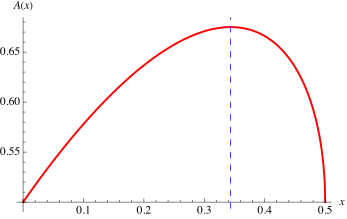
This function is plotted above. The parameter interval is , with and .
The unique maximum occurs at a stationary
point in (Graham 1975, pp. 168-169). The same algebraic
optimization can be formulated using Lagrange
multipliers for the unit-distance constraints and
a Gröbner basis to eliminate the coordinates
and multipliers (Trott 2006).
Maximizing gives the area of the hexagon
as the second-largest real root of
(5)
approximately given by (OEIS A111969).
Note that the sign of the is positive, not negative as erroneously given in Conway
and Guy (1996). Also compare this with the area of the regular hexagon of polygon
diameter 1 (and therefore having circumradius
1/2), which is given by
(6)
so the optimal solution is 3.9% larger.
The values of and corresponding to the maximal solution are given by
Audet, C.; Hansen, P.; Messine, F.; and Perron, S. "The Minimum Diameter Octagon with Unit-Length Sides: Vincze's Wife's Octagon Is Suboptimal."
J. Combin. Th. Ser. A108, 63-75, 2004.Audet, C.; Hansen,
P.; Messine, F.; and Xiong, J. "The Largest Small Octagon." J. Combin.
Th. Ser. A98, 46-59, 2002.Conway, J. H. and Guy, R. K.
"Graham's Biggest Little Hexagon." In The
Book of Numbers. New York: Springer-Verlag, pp. 206-207, 1996.Foster,
J. and Szabó, T. "Diameter Graphs of Polygons and the Proof of a Conjecture
of Graham." J. Combin. Th. Ser. A114, 1515-1525, 2007. https://doi.org/10.1016/j.jcta.2007.02.006.Graham,
R. L. "The Largest Small Hexagon." J. Combin. Th. Ser. A18,
165-170, 1975. https://doi.org/10.1016/0097-3165(75)90004-7.Hurst, G. "A Closed Form Expression for the Area of the 'Biggest Little'
Octagon and Decagon." Wolfram Community. Apr. 14, 2025. https://community.wolfram.com/t/25370.Klein,
A. and Wessler, M. "The Largest Small -Dimensional Polytope with Vertices." J. Combin. Th. Ser. A102,
401-409, 2003. https://doi.org/10.1016/S0097-3165(03)00054-2.Klein,
A. and Wessler, M. "A Correction to 'The Largest Small -Dimensional Polytope with Vertices': [J. Combin. Theory Ser. A 102 (2003) 401-409]."
J. Combin. Th. Ser. A112, 173-174, 2005. https://doi.org/10.1016/j.jcta.2005.06.001.Numberphile.
"The Largest Small Hexagon." Dec. 17, 2021. https://www.youtube.com/watch?v=1kYGbMK1oA4.Sloane,
N. J. A. Sequences A111969, A111970,
and A111971 in "The On-Line Encyclopedia
of Integer Sequences."Trott, M. The
Mathematica GuideBook for Symbolics. New York: Springer-Verlag, pp. 46-47,
2006. https://doi.org/10.1007/0-387-28815-5.
https://www.mathematicaguidebooks.org/.


 . The solution is given by the above figure (which
is shown with incorrect proportions in Conway and Guy 1996, p. 207), in which
the red lines are all diagonals
of unit length.


 and
 then gives the formula for
 as

 , with
 and
 .
The unique maximum occurs at a stationary
point in
 (Graham 1975, pp. 168-169). The same algebraic
optimization can be formulated using Lagrange
multipliers for the unit-distance constraints and
a Gröbner basis to eliminate the coordinates
and multipliers (Trott 2006).

 (OEIS A111969).
Note that the sign of the
 is positive, not negative as erroneously given in Conway
and Guy (1996). Also compare this with the area of the regular hexagon of polygon
diameter 1 (and therefore having circumradius
1/2), which is given by

 and
 corresponding to the maximal solution are given by



 Hurst, G. "A Closed Form Expression for the Area of the 'Biggest Little'
Octagon and Decagon." Wolfram Community. Apr. 14, 2025.
 -Dimensional Polytope with
 Vertices." J. Combin. Th. Ser. A 102,
401-409, 2003.
 -Dimensional Polytope with
 Vertices': [J. Combin. Theory Ser. A 102 (2003) 401-409]."
J. Combin. Th. Ser. A 112, 173-174, 2005.