


The Gömböc (meaning "sphere-like" in Hungarian) is the name given to a class of homogeneous convex solids which possess a unique stable and a unique unstable point of equilibrium. Gömböcs were conjectured to exist by V. Arnold in 1995 and first shown to exist by Domokos and Várkonyi in 2006 (Rehmeyer 2007). The Gömböcs originally discovered resembled pinched spheres with steep backs and flattened bottoms. Domokos and Várkonyi (2008) subsequently showed how the geometry of highly domed turtle shells (which are similar in shape to a Gömböc) is close to optimal for self-righting.

Polyhedral skeletons (and solids) belonging to this class are known as mono-monostatic polyhedra (Várkonyi and Domokos 2006a, Domokos et al. 2020, Domokos and Kovács 2023). While the existence of homogeneous, mono-monostatic polyhedral solids has been proven (Lángi 2022), no example is known (Domokos and Kovács 2023). However, Domokos and Kovács (2023) describe an example of a mono-monostatic 0-polyhedron (i.e., a polyhedron with mass uniformly distributed over its vertices) having 21 faces and 21 vertices, illustrated above.
Sloan (2023) proposed two radial constructions in spherical coordinates,
 |
(1)
|
and
 |
(2)
|
where  is a small positive constant. However,
the proposed bounds
 and
 in Sloan (2023) do not ensure
convexity. At the equatorial radial minima
of the first surface with
 and the second with
 , their Gaussian
curvatures are respectively
 |  |  |
(3)
|
 |  | 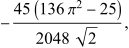 |
(4)
|
so both surfaces are nonconvex at those parameter values. The first construction also fails to define a C2
function on the unit sphere for  , contrary to the smoothness claim in Sloan (2023).
This regularity defect does not by itself rule out a Gömböc at smaller
 .

For the second construction, a sufficient condition for strict convexity is
 |
(5)
|
The solid has its center of mass at the origin and, under this condition, has
unique stable and unstable equilibrium points at  and
 , respectively. The illustration uses
 . Couey (2026) reported numerical evidence for strict
convexity of the second construction up to approximately
 .

 :
A Strict-Convexity-Constrained Reanalysis." 23 May 2026.