

A generic solution of a parameter-dependent equation or system of equations is a solution valid
for general parameter values, with exceptional values
handled separately (Trott 2006). For polynomial
equations with parameters in  , a common algebraic meaning of "generic" is validity
on a nonempty open set in the Zariski
topology. The excluded values then lie in a proper
subset defined by polynomial equations.
A generic solution formula need not describe the complete solution
set at those exceptional values.
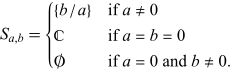
For example, consider
 |
(1)
|
where  are parameters. The generic solution is
 , valid for
 . The complete solution set
is
 |
(2)
|
Thus dividing by a parameter can omit both an identity and an inconsistent equation.
Over the real numbers, the number of real roots can differ on open sets in the usual metric
topology of parameter values. For example,  has two real
roots for
 ,
none for
 ,
and one for
 .
A generic complex solution description therefore does not imply a single real
root count (Lazard and Rouillier 2007).
