

A generalized Keller graph has as its vertices the n-tuples over the integers
0, 1, ...,  .
Two vertices are adjacent
if they differ by exactly
.
Two vertices are adjacent
if they differ by exactly  in at least one coordinate and differ in at least two coordinates
(Brakensiek et al. 2022). By definition, it is a Cayley
graph of the additive group
in at least one coordinate and differ in at least two coordinates
(Brakensiek et al. 2022). By definition, it is a Cayley
graph of the additive group  whose connection set
consists of the vectors having at least one coordinate
equal to
whose connection set
consists of the vectors having at least one coordinate
equal to  and at least two nonzero coordinates. This set is inverse-closed
because taking additive inverses modulo
and at least two nonzero coordinates. This set is inverse-closed
because taking additive inverses modulo  preserves both properties.
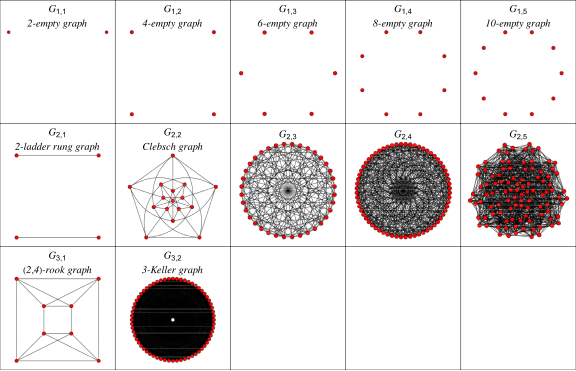
The generalized Keller graph with parameters  and
and  is denoted
  , or
, or  after the notation
  of Łysakowska (2023). Its vertex set therefore has
  elements. The ordinary
  -dimensional Keller graph
  is the special case
  .
.
Special cases, including the natural boundary cases with  or
or  , are summarized in the following table.
 | graph |
 |  -empty graph -empty graph |
 | ladder rung graph  |
 | Clebsch graph |
 |  rook graph rook graph |
 |  -dimensional Keller graph -dimensional Keller graph |
For  ,
generalized Keller graphs are vertex-transitive
and regular, with vertex
degree
,
generalized Keller graphs are vertex-transitive
and regular, with vertex
degree  .
Their chromatic number is
.
Their chromatic number is  , and their independence
number is
, and their independence
number is  for
for  .
In addition, Łysakowska (2023) proved that all generalized Keller graphs are
Hamiltonian and class
1.
.
In addition, Łysakowska (2023) proved that all generalized Keller graphs are
Hamiltonian and class
1.
Corrádi and Szabó (1990) introduced the graphs  to give a convenient finite graph-theoretic formulation
of Keller's conjecture, translating the search
for face-sharing-free periodic hypercube tilings
into a clique problem. A clique
in
to give a convenient finite graph-theoretic formulation
of Keller's conjecture, translating the search
for face-sharing-free periodic hypercube tilings
into a clique problem. A clique
in  has size at most
  , and one attaining this bound gives a face-sharing-free
tiling of
, and one attaining this bound gives a face-sharing-free
tiling of  -dimensional space. It therefore disproves Keller's
conjecture in dimension
-dimensional space. It therefore disproves Keller's
conjecture in dimension  and all higher dimensions. Łysakowska (2023) later used
the term generalized Keller graph for the family and studied its graph-theoretic
properties.
and all higher dimensions. Łysakowska (2023) later used
the term generalized Keller graph for the family and studied its graph-theoretic
properties.
For the remaining seven-dimensional case, Brakensiek et al. (2022) encoded the clique search as a satisfiability problem
and used symmetry breaking to prove that none of  ,
,  , and
, and  contains a clique of size
128. This settled Keller's conjecture by proving
it in dimension seven.
contains a clique of size
128. This settled Keller's conjecture by proving
it in dimension seven.
Generalized Keller graphs are implemented in the Wolfram Language as GraphData[ "GeneralizedKeller",
 n,
s
n,
s
 ].
].
