


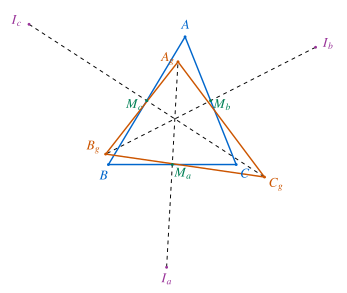
The García reflection triangle of a nondegenerate reference triangle  is the triangle
 obtained by reflecting
each excenter in the midpoint
of the corresponding side. These are point
reflections, so in radius vectors,
 |  |  |
(1)
|
 |  |  |
(2)
|
 |  |  |
(3)
|
where  ,
 ,
and
 are the excenters opposite
 ,
 , and
 , respectively (Dalcín and Kiss 2021).
Writing  ,
 ,
and
 ,
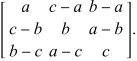
its vertices have homogeneous barycentric
coordinates given by the rows of
 |
(4)
|
The row sums are  ,
 , and
 . Dividing each row by its sum gives a matrix
with determinant 1, so the García reflection
triangle has the same area as the reference
triangle (Dalcín and Kiss 2021).
The vertex  is also the orthocenter
of
 ,
where
 is the incenter, with the other two vertices
obtained cyclically. Equivalently, the García reflection triangle is the anticevian triangle of
 with respect to the contact
triangle (Dalcín and Kiss 2021). The triangle
centroid of
 is the midpoint of the centroids
of the García reflection triangle and the excentral
triangle (Dalcín and Kiss 2021).
It is perspective to the outer García triangle at the Nagel point (Dalcín and Kiss 2021). It is also perspective to the Fuhrmann triangle at the Nagel point in the nondegenerate case (Kimberling).
The inner García triangle uses reflections of the incenter in the perpendicular bisectors of the sides.

 .