

The fundamental matrix subspaces of a real  matrix
 are four associated vector subspaces,
namely the column spaces and the null
spaces of the matrices
 and its transpose
 . These four subspaces are important
for a number of reasons, one of which is the crucial role they play in the so-called
fundamental theorem of linear algebra.
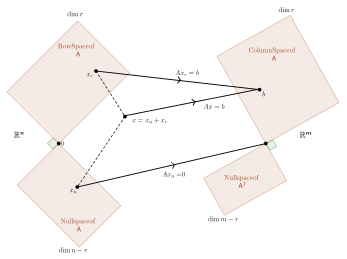
The above figure summarizes some of the interactions between the four fundamental matrix subspaces for a real  matrix
 including whether the spaces
in question are subspaces of
 or
 , which pairs of subspaces are
orthogonal subspaces, and how the matrix
 maps various vectors
 relative to the subspace in which
 lies.
When  and
 has matrix rank 1, all four of the fundamental matrix
subspaces are lines in
 . In this case, one can write
 for some
 vectors
 , whereby the directions of
the four lines correspond to
 ,
 ,
 , and
 . An elementary fact from linear
algebra is that these directions are also represented
by the eigenvectors of
 and
 (Strang 2008); this is one of the reasons why the four fundamental
subspaces of
 are often associated with the eigenvalues
and the singular value decompositions
of
 and
 in many presentations of the fundamental
theorem of linear algebra (Strang 2012).
