

The fundamental theorem of linear algebra for a real  matrix
 is a collection of results relating various properties of
the four fundamental matrix subspaces
of
 .
In particular:
1.  and
 where here,
 denotes the range or column
space of
 ,
 denotes its transpose, and
 denotes its null space.
2. The null space  is orthogonal to the
row space
 .
3. There exist orthonormal bases for both the column space  and the row space
 of
 .
4. The orthonormal bases of  and
 can be chosen so that the restricted linear
transformation represented by
 has a diagonal matrix.
The third item on this list stems from Gram-Schmidt Orthonormalization; the fourth item stems from the singular
value decomposition of  . Also, while different, the first item is reminiscent of the
rank-nullity theorem.
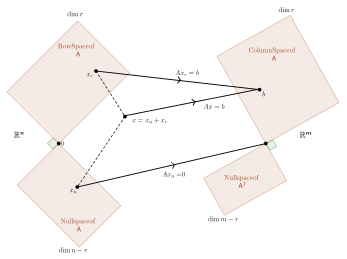
The above figure summarizes some of the interactions between the four fundamental matrix subspaces for a real  matrix
 including whether the spaces in question are subspaces
of
 or
 ,
which subspaces are orthogonal
to one another, and how the matrix
 maps various vectors
 relative to the subspace in which
 lies. This diagram essentially makes visual the first
two parts of the above-stated result.
Worth noting is that this theorem is often stated differently and with varying numbers of parts. In particular, it is relatively common for versions of this theorem to include only the first two items given above, though the importance of the last two items is often cited to justify stating a four-part version like the above (Strang 1993). Some authors also include corollaries of the above statements within the statements themselves (Badger 2012).
