

The first-passage time, or hitting time, of a stochastic process  to a set
  is the random variable
 |
(1)
|
For a discrete-time process, the infimum is taken over the nonnegative integers.
Under the usual adaptedness assumptions,  is a stopping time.
The distribution function  and survival function
  of
of  satisfy
 |  |  |
(2)
|
 |  |  |
(3)
|
If the distribution has a probability density function  , then
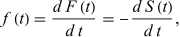 |
(4)
|
and the mean first-passage time can be written as
![E[tau_A]=int_0^inftyS(t)dt,](/images/equations/First-PassageTime/NumberedEquation3.svg) |
(5)
|
with the value possibly infinite.
For example, let  ,
where
,
where  is a standard Brownian motion, and let
  . The density of the first-passage time to
  is
is
 |
(6)
|
This formula holds for  . Although the process reaches
  with probability one, this
distribution has infinite expectation
value. Introducing stochastic resetting
can make the corresponding mean first-passage time finite.
with probability one, this
distribution has infinite expectation
value. Introducing stochastic resetting
can make the corresponding mean first-passage time finite.
