


Fermat's stationary point theorem states that if a real-valued function  of a real variable has a
local extremum at a point
of a real variable has a
local extremum at a point  in the interior of its domain
and is differentiable at
in the interior of its domain
and is differentiable at  , then
 |
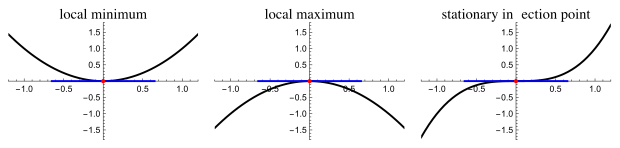
The illustration shows the horizontal tangents at a differentiable local minimum and local
maximum, together with a stationary point
that is an inflection point. The converse
is false: a stationary point need not be a local maximum or local
minimum. For example,  has
has  , but no local extremum
at 0. The hypotheses also matter. The nondifferentiable function
, but no local extremum
at 0. The hypotheses also matter. The nondifferentiable function  has a local minimum at 0, where
  is the absolute value
of
is the absolute value
of  .
.
