FFTs were first discussed by Cooley and Tukey (1965), although Gauss had actually described the critical factorization step as early as 1805 (Bergland 1969, Strang
1993). A discrete Fourier transform
can be computed using an FFT by means of the Danielson-Lanczos
lemma if the number of points is a power of two. If the number
of points
is not a power of two, a transform can be performed on
sets of points corresponding to the prime factors of which is slightly degraded in speed. An efficient real Fourier
transform algorithm or a fast Hartley transform
(Bracewell 1999) gives a further increase in speed by approximately a factor of two.
Base-4 and base-8 fast Fourier transforms use optimized code, and can be 20-30% faster
than base-2 fast Fourier transforms. prime factorization
is slow when the factors are large, but discrete Fourier transforms can be made fast
for ,
3, 4, 5, 7, 8, 11, 13, and 16 using the Winograd
transformalgorithm (Press et al. 1992,
pp. 412-413, Arndt).
Fast Fourier transform algorithms generally fall into two classes: decimation in time, and decimation in frequency. The Cooley-Tukey FFT algorithm
first rearranges the input elements in bit-reversed order, then builds the output
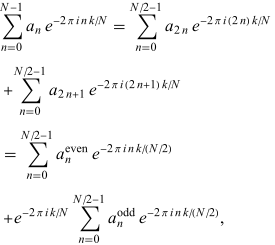
transform (decimation in time). The basic idea is to break up a transform of length
into two transforms of length using the identity


 points from
  to
to  , where lg is the base-2 logarithm.
 is a power of two. If the number
of points
is a power of two. If the number
of points  is not a power of two, a transform can be performed on
sets of points corresponding to the prime factors of
is not a power of two, a transform can be performed on
sets of points corresponding to the prime factors of  which is slightly degraded in speed. An efficient real Fourier
transform algorithm or a fast Hartley transform
(Bracewell 1999) gives a further increase in speed by approximately a factor of two.
Base-4 and base-8 fast Fourier transforms use optimized code, and can be 20-30% faster
than base-2 fast Fourier transforms. prime factorization
is slow when the factors are large, but discrete Fourier transforms can be made fast
for
which is slightly degraded in speed. An efficient real Fourier
transform algorithm or a fast Hartley transform
(Bracewell 1999) gives a further increase in speed by approximately a factor of two.
Base-4 and base-8 fast Fourier transforms use optimized code, and can be 20-30% faster
than base-2 fast Fourier transforms. prime factorization
is slow when the factors are large, but discrete Fourier transforms can be made fast
for  ,
3, 4, 5, 7, 8, 11, 13, and 16 using the Winograd
transform algorithm (Press et al. 1992,
pp. 412-413, Arndt).
,
3, 4, 5, 7, 8, 11, 13, and 16 using the Winograd
transform algorithm (Press et al. 1992,
pp. 412-413, Arndt).
 into two transforms of length
  using the identity