


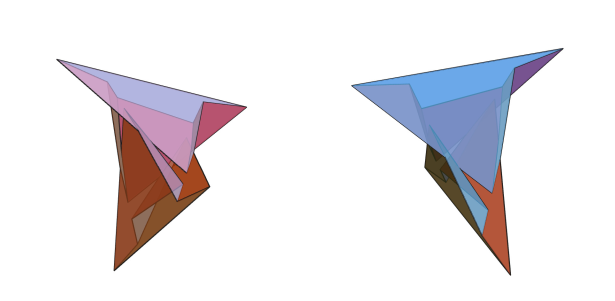
The equivelar octahedron of genus 3 constructed by Mizhaev (2020, 2026) is an integer-coordinate polyhedral surface with eight planar simple nonagons. It is an octahedron in the general sense of an eight-faced polyhedron. It has 24 polyhedron vertices, 36 polyhedron edges, and eight faces, so its Euler characteristic is
 |
giving genus 3.
Every face is a 9-cycle and every vertex has vertex degree 3, so the corresponding equivelar
map has type  . Its skeleton is a cubic
graph of girth 5 whose automorphism
group is the cyclic group C4.
This group is realized by the geometric symmetries, and the equivelar map is therefore
not a regular map.
. Its skeleton is a cubic
graph of girth 5 whose automorphism
group is the cyclic group C4.
This group is realized by the geometric symmetries, and the equivelar map is therefore
not a regular map.
Every pair of the eight faces shares at least one polygon edge. Twenty pairs share one edge and eight
pairs share two disjoint edges. The face-adjacency multigraph
therefore has 36 edges and underlying complete graph  .
Because some face pairs share two disjoint edges, this example uses the cellular-embedding
convention for a polyhedral surface rather than the stricter polyhedral-complex convention
in which two faces intersect in at most one edge.
.
Because some face pairs share two disjoint edges, this example uses the cellular-embedding
convention for a polyhedral surface rather than the stricter polyhedral-complex convention
in which two faces intersect in at most one edge.
The 24 integer vertex coordinates, eight face walks, and eight supporting-plane equations give an exact certificate for the realization. Integer-arithmetic checks verify planarity, closure, orientability, the absence of unintended face intersections, and the stated symmetry (Mizhaev 2026). The integer realization preserves the incidence structure of an earlier realization by Mizhaev (2020).
