


Equidistant lines are a collection of distinct lines whose pairwise line-line distance is the same. For
lines  in Euclidean space, this
condition is
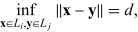 |
where  and
 . For example, three parallel
lines through the vertices of an equilateral
triangle perpendicular to them have this property.
In three-dimensional Euclidean space, the problem is equivalent to finding pairwise touching congruent infinite right circular cylinders with disjoint interiors. The axes of such cylinders have common pairwise line-line distance twice their radius.

Littlewood's cylinder problem asks whether seven infinite right circular cylinders of radius 1 can touch pairwise with disjoint interiors (Littlewood 1968, p. 20). Bozóki et al. (2015) answered this question affirmatively by constructing seven such cylinders, as illustrated above.
The finite version includes Gardner's cigarette problem. Gardner (1959, p. 115) gives an arrangement of seven congruent
finite right circular cylinders in which
every pair touches, provided the ratio of length
to diameter is at least  . Gardner's construction uses contacts at the
end rims, and some of its axes intersect. Extending the
cylinders infinitely in both directions would therefore
cause their interiors to overlap, so this construction
does not solve Littlewood's problem.
Liu (2026a) reported that eight lines in three-dimensional Euclidean space cannot have common positive pairwise line-line distance. Together with the seven-line construction, this would give a maximum of seven. The written argument combines geometric reductions with exact computations for possible configurations of directions. The project reports substantial assistance from OpenAI and Anthropic models (VibeMathed 2026).
As of Oct. 7, 2026, VibeMathed (2026) had independently rebuilt the accompanying Lean development from a clean clone and replayed it with a separate kernel checker. The formal statement excludes eight lines at common positive pairwise line-line distance, without assumptions of general position or nonparallel directions. The formalization includes the complete exclusion argument, but not the published seven-line construction or the cylinder reformulation (Liu 2026b). Independent specialist review of the mathematical statement and proof had not been reported.
The requirement that every pair of cylinders touch is different from Kuperberg's six-cylinder conjecture, which concerns cylinders touching a common unit ball.
Matić et al. (2026) independently proved that eight lines in  cannot have the same positive pairwise line-line
distance. Together with the seven-line construction, this settles Littlewood's
cylinder problem. Their proof uses a finite computer-assisted
exclusion.
The three-dimensional line problem also controls equidistant affine subspaces of codimension two. Let  be the largest number of affine
 -planes in
 at a common strictly positive pairwise separation distance.
Li (2026) proved
 for every
 . Every such family of
 -planes has a common
 -dimensional direction factor, and quotienting by that
factor preserves pairwise distances. Thus the known maximum of seven lines also gives
the maximum number of these codimension-two affine subspaces.

 Cannot Have Pairwise Distance One." 2026a.
 ." Sep. 30, 2026.