


Gardner's cigarette problem asks for an arrangement of six congruent finite right circular cylinders with disjoint interiors in which each touches every other. The original puzzle specifies unbent, unbroken cigarettes (Gardner 1959, p. 110).
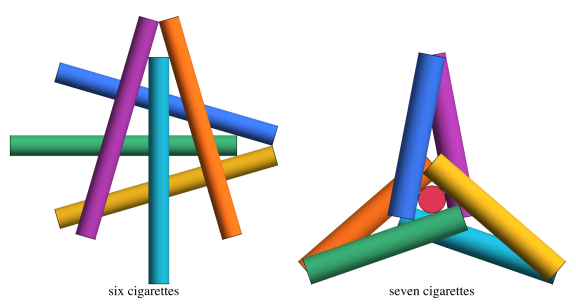
The traditional six-cigarette solution is shown at left, and a stronger solution with seven cigarettes is shown at right (Gardner 1959, pp. 114-115, Figs. 54-55).
Gardner credits the diagram of the seven-cigarette arrangement to George Rybicki
and John Reynolds. The construction uses two layers of three cigarettes surrounding
a central cigarette whose axis is perpendicular
to the layers, and works when the ratio of length  to diameter
 satisfies
 |
At equality, some contacts involve the end rims. Removing the central cigarette gives a symmetric six-cigarette solution. This is a sufficient condition for the construction, rather than a claim that the ratio is the smallest possible for every seven-cigarette arrangement.
A different seven-cigarette solution can be obtained by truncating the infinite-cylinder configuration of Bozóki et al. (2015). Choosing suitable segments of length 32 on its seven axes gives cylinders of radius 1 that retain all 21 pairwise contacts.
The infinite-cylinder counterpart is Littlewood's cylinder problem (Littlewood 1968, p. 20), which is equivalent to finding seven equidistant lines in three-dimensional Euclidean space. Gardner's construction uses contacts at the end rims, and some of its axes intersect. Extending the cylinders infinitely in both directions would therefore cause their interiors to overlap, so this construction does not solve Littlewood's problem. For congruent infinite right circular cylinders, the common line-line distance of their axes is twice the radius. The finite and infinite contact problems are distinct from maximizing the packing density in cylinder packing.
