

An elementary recursive function, also called a Kalmár function, is a total function  , where
 denotes the nonnegative
integers, belonging to the smallest class containing the constant
functions, the coordinate functions
 for
 , addition, and truncated
subtraction
 , and closed under function
composition, bounded sums, and bounded products.
Here
 denotes the maximum. The bounded operations take an elementary
recursive function
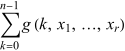
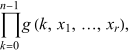
 to the functions
 |  |  |
(1)
|
 |  |  |
(2)
|
with the empty sum equal to 0 and the empty product equal to 1. Every elementary recursive function is a primitive recursive function.
Every elementary recursive function has a finite expression using constants, variables, addition, truncated
subtraction, power, and
integer division  , where
 is the floor function
(Mazzanti 2002, Marchenkov 2007). The convention
 makes the power operation total
on the nonnegative integers.
A smaller collection of operations generating the same class under function composition, together with constants and the coordinate
functions, consists of addition, integer remainder,
and the exponential function  (Prunescu et al. 2026). Here
 is used so that the remainder
operation is a total function. This collection
is minimal under deletion of any one of its three operations.
