


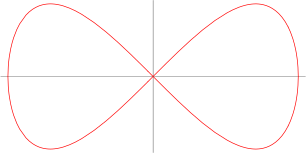
An eight curve is a curve also known as the Gerono lemniscate. For  ,
it is given by Cartesian coordinates
 |
(1)
|
 |
(2)
|
and parametric equations, with real  ,
 |  |  |
(3)
|
 |  |  |
(4)
|
It has vertical tangents at  and horizontal tangents
at
 .
Setting  ,
 , and
 in the equation of the eight
surface (i.e., scaling by half and relabeling the
 -axis as the
 -axis) gives the eight curve.
The area of the curve is
 |
(5)
|
The signed curvature and tangential angle are
 |  |  |
(6)
|
 |  |  |
(7)
|
where the complex argument is chosen continuously with  , giving the direction of the tangent
vector.
The arc length of the entire curve is given by
 |  |  |
(8)
|
 |  |  |
(9)
|
 |  |  |
(10)
|
 |  |  |
(11)
|
 |  |  |
(12)
|
 |  |  |
(13)
|
(OEIS A118178), where  is a complete
elliptic integral of the first kind,
 is a complete
elliptic integral of the second kind, and
 is a complete elliptic
integral of the third kind, all with elliptic
modulus
 (D. W. Cantrell, pers. comm., Apr. 22, 2006). The arc
length also has a surprising connection to 1-dimensional random
walks via
 |
(14)
|
where
 |  |  |
(15)
|
 |  |  |
(16)
|
 |  |  |
(17)
|
and  is a regularized
hypergeometric function. The first values of
 for
 , 1, ... are 1, 0, 4, 6, 36,
100, ... (OEIS A092765; M. Alekseyev,
pers. comm., Apr. 19, 2006).
