


The EML operator, where "EML" is short for exp-minus-log, is defined by Odrzywołek (2026) as the binary operator
 |
(1)
|
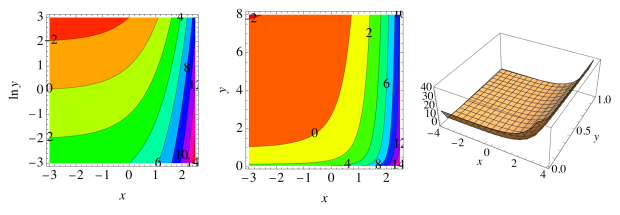
As a real-valued function of two variables, the EML operator is plotted above on a portion of the domain  .
.
Odrzywołek (2026) showed constructively that, together with the constant 1, this operator can express a fixed scientific-calculator basis of elementary functions and operations by repeated composition. For example,
 |  |  |
(2)
|
 |  |  |
(3)
|
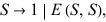
Expressions using only  and 1 are generated by the grammar
 |
(4)
|
where  denotes an expression and
  denotes alternation. Thus each such expression is a binary
tree with a single type of internal node. In this sense, the EML operator is
analogous to the NAND operator for Boolean
logic, with the qualification that the construction is for the specified basis of
elementary functions and may use complex
intermediate values.
denotes alternation. Thus each such expression is a binary
tree with a single type of internal node. In this sense, the EML operator is
analogous to the NAND operator for Boolean
logic, with the qualification that the construction is for the specified basis of
elementary functions and may use complex
intermediate values.
