

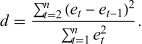
The Durbin-Watson statistic is a statistic for detecting first-order serial correlation in the residuals  , ...,
  of a regression. It is defined
by
of a regression. It is defined
by
 |
First-order serial correlation is the autocorrelation  between consecutive residuals. The statistic satisfies
  , with values near 2 indicating little first-order
autocorrelation. If
, with values near 2 indicating little first-order
autocorrelation. If  is the lag-one residual sample
autocorrelation, then
is the lag-one residual sample
autocorrelation, then  .
.
The null distribution depends on the regression design, and the usual Durbin-Watson inference is not generally valid when a previous
value of the dependent variable, such as  ,
is included among the regressors. Such a regressor
contains the preceding model error, so the standard Durbin-Watson reference distribution
does not apply.
,
is included among the regressors. Such a regressor
contains the preceding model error, so the standard Durbin-Watson reference distribution
does not apply.
