

The von Neumann ratio is a statistic comparing the mean square successive difference of ordered observations  ,
,  , ...,
  with their sample variance.
For nonconstant observations, if
with their sample variance.
For nonconstant observations, if  is the sample mean, the ratio
is
is the sample mean, the ratio
is
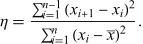 |
The numerator measures local change between consecutive observations, while the denominator measures overall
statistical dispersion. The ratio satisfies
 . Values near 2 indicate
little first-order serial correlation, smaller
values indicate positive serial correlation,
and larger values indicate negative serial correlation
or alternation.
. Values near 2 indicate
little first-order serial correlation, smaller
values indicate positive serial correlation,
and larger values indicate negative serial correlation
or alternation.
The ratio can be used to test whether an observed ordering is consistent with randomness (von Neumann 1941). The Bartels rank test replaces the observations by their statistical ranks, making the resulting procedure a nonparametric test (Bartels 1982). The Durbin-Watson statistic uses the same successive-difference form for regression residuals.
