

A discrete harmonic function on a finite connected simple graph  with at least two vertices
is a real-valued function whose value at each specified
graph vertex is the arithmetic
mean of its values at the adjacent vertices.
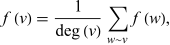
Writing
 for adjacent vertices, this condition is
 |
(1)
|
where  is the vertex degree. This averaging condition is
a discrete analog of the condition satisfied by a harmonic
function.
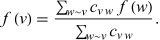
More generally, assign a positive real number  to each graph edge. The weighted harmonicity condition
replaces the arithmetic mean by
 |
(2)
|
The unweighted condition is recovered when all  (Doyle and Snell 2006, p. 36).
For a nonempty subset  of the vertex set
 , arbitrary real values prescribed on
 have a unique extension to
 that is harmonic at every graph
vertex in
 . Its values lie between the smallest and largest
prescribed values. To prove this bound, suppose a global largest value is attained
outside
 . Positivity in the averaging equation forces every
graph vertex adjacent
to it to have the same value. Repeating this argument along a graph
path to
 shows that the largest value is attained on
 .
Applying the same argument to
 gives the lower bound.
The difference of two extensions with the same boundary values is harmonic and zero on  ,
so the bounds force it to vanish everywhere. This proves uniqueness. Existence is
immediate if
 . Otherwise the interior averaging equations form
a linear system of equations with as
many equations as unknown interior values. With zero boundary values, the uniqueness
argument gives only the zero solution, so its coefficient matrix
is nonsingular and every choice of boundary
values has a solution. This extends the averaging argument for finite grids and two-boundary
networks to any nonempty
 (Doyle and Snell 2006, pp. 13-14 and 36; Nachmias 2020).
The definition also applies to infinite locally finite graphs. On the integer lattice  ,
with edges between points differing by one standard
basis vector, harmonicity is the condition that each value is the average of
its
 nearest-neighbor values. Hu (2026) reports the following one-sided Liouville and
sparse-support results for this unweighted lattice.
There is an absolute  such that a real harmonic function on
 is constant if it is nonnegative at at least a proportion
 of the points in every sufficiently large centered square. More strongly, for every
nonconstant such function and every fixed real
 , both sets
 and
 occupy an absolute positive proportion of the same
arbitrarily large centered squares. The conclusion need not hold at every large scale:
a single function can be positive on a proportion tending to 1 along one sequence
of squares and negative on a proportion tending to 1 along another. Each fixed strict
level set nevertheless contains at least
 points in every sufficiently large square
 , for an absolute
 , and the logarithmic order is attained along a
sequence (Hu 2026).
In dimension three, put  .
For each
 there is a constant
 such that, for every integer
 , a complex-valued function harmonic in
 with at most
 nonzero values there has its support in
 contained in at most
 planes
 ,
where
 and
 is an integer. For a fixed nonzero whole-lattice harmonic function, the following
are equivalent: its support has
 points in
 along an unbounded sequence;
the support lies in finitely many such planes; and its complex closure in the Zariski topology is a proper
subset of
 . There is then a unique irredundant family of
 planes, and the support count is
 (Hu 2026).
If  is the minimum support count in
 over whole-lattice harmonic functions with
 , then
 |
(3)
|
The upper bound is attained by the example  when
 and
 otherwise. Just above the quadratic scale, the support
can be much less rigid: for every positive
 ,
there is a real harmonic function whose translates are dense in the space of real
whole-lattice harmonic functions for pointwise
convergence and for which
 tends to infinity while
remaining at most
 for all sufficiently large
 (Hu 2026).
In every dimension, if a real lattice harmonic function is nonnegative outside a proper real algebraic set, it agrees there with
a unique nonnegative constant  .
The vanishing ideals of
 and
 coincide. For every nonconstant real harmonic function
on
 ,
 ,
the complex Zariski closure of each fixed strict level set
has dimension at least
 ,
and this bound is sharp (Hu 2026). Hu (2026) reports that AI agents developed the
characteristic-plane inverse argument and the contact-set argument for the planar
theorem.
