

The discrete-time Fourier transform, abbreviated DTFT, represents a doubly infinite sequence  by a periodic function
of a continuous frequency variable. One common convention is
by a periodic function
of a continuous frequency variable. One common convention is
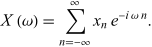 |
Here  is the imaginary unit. If
  , this series
has uniform convergence to a continuous
function with period
, this series
has uniform convergence to a continuous
function with period  . The inverse formula is
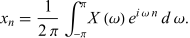 |
Thus the samples  are Fourier series coefficients
of
are Fourier series coefficients
of  ,
with the indicated sign convention.
,
with the indicated sign convention.
The frequency variable of the DTFT is continuous, unlike that of the discrete Fourier transform. If  outside
  , ...,
  , the discrete Fourier
transform with negative exponential and no forward normalization samples the
DTFT at
, the discrete Fourier
transform with negative exponential and no forward normalization samples the
DTFT at  for
for  ,
...,
,
...,  .
.
