TOPICS
Search

Discrete-Time Fourier Series


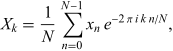
The discrete-time Fourier series, abbreviated DTFS, represents a periodic sequence. If x_(n+N)=x_n, its Fourier coefficients are

 X_k=1/Nsum_(n=0)^(N-1)x_ne^(-2piikn/N),

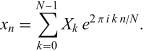
where X_(k+N)=X_k. The inverse series is

 x_n=sum_(k=0)^(N-1)X_ke^(2piikn/N).

Thus one period of the sequence and one period of its coefficients form a discrete Fourier transform pair, with the normalization placed in the forward formula above. The DTFS applies to periodic discrete-time sequences, whereas the discrete-time Fourier transform applies to sequences that need not be periodic.


See also

Discrete Fourier Transform, Discrete-Time Fourier Transform, Fourier Series

Explore with Wolfram|Alpha

References

Oppenheim, A. V.; Schafer, R. W.; and Buck, J. R. Discrete-Time Signal Processing, 2nd ed. Upper Saddle River, NJ: Prentice-Hall, 1999.

Cite this as:

Weisstein, Eric W. "Discrete-Time Fourier Series." From MathWorld--A Wolfram Resource. https://mathworld.wolfram.com/Discrete-TimeFourierSeries.html

Subject classifications