


A pitchfork bifurcation is a local bifurcation of equilibrium solutions in a one-parameter family of ordinary differential equations
 |
(1)
|
in which one equilibrium branch meets two additional branches at a critical value of the parameter 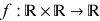 . In a bifurcation diagram plotting the equilibrium value
of
. In a bifurcation diagram plotting the equilibrium value
of  against
  ,
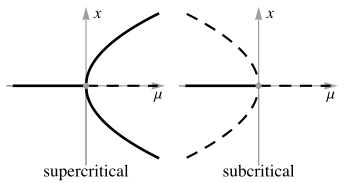
the three branches have the shape of a pitchfork. In the figure above, solid curves
denote linearly stable equilibria and dashed curves denote unstable equilibria.
,
the three branches have the shape of a pitchfork. In the figure above, solid curves
denote linearly stable equilibria and dashed curves denote unstable equilibria.
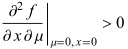
There is no special significance to placing the bifurcation at 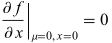 . If it occurs at
  , the coordinate shifts
  and
and  move the critical point to the origin.
After relabeling
move the critical point to the origin.
After relabeling  and
and  as
as  and
and  ,
a family with reflection symmetry
satisfies
,
a family with reflection symmetry
satisfies
 |  |  |
(2)
|
 |  |  |
(3)
|
 |  |  |
(4)
|
 |  |  |
(5)
|
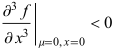
where subscripts denote partial derivatives. These symmetry and nondegeneracy conditions give a pitchfork bifurcation (Rasband 1990, p. 31). The signs of the last two derivatives determine its orientation and whether it is supercritical or subcritical (Guckenheimer and Holmes 1997, pp. 145 and 149-150).
The supercritical normal form is
 |
(6)
|
For  ,
the only equilibrium is
,
the only equilibrium is  , and it is stable. For
  , the equilibrium
  is unstable and the two new equilibria
  are stable. The subcritical normal form is
 |
(7)
|
For  ,
the central equilibrium
,
the central equilibrium  is stable and the two equilibria
  are unstable, while for
  only the unstable central equilibrium remains. Reversing
the direction of the parameter presents this as one
unstable equilibrium splitting into three, with a stable middle branch and two unstable
outer branches. These stability statements follow by linear
stability analysis of
only the unstable central equilibrium remains. Reversing
the direction of the parameter presents this as one
unstable equilibrium splitting into three, with a stable middle branch and two unstable
outer branches. These stability statements follow by linear
stability analysis of  .
.
An exact pitchfork is commonly enforced by symmetry; a perturbation that breaks the symmetry generally unfolds the pitchfork into a different local bifurcation pattern.
