

The Descartes circle theorem relates the signed curvatures of four mutually tangent circles, with no three tangent at a common point. The relation is
 |
(1)
|
where  for a circle of radius
 that encloses none of the others, and
 for a circle enclosing
the other three. A line is included as a limiting circle
with
 (Soddy 1936, Eppstein 2001).
For three pairwise externally tangent circles with positive curvatures  ,
 ,
and
 ,
the two solutions of Apollonius' problem have
curvatures
 |
(2)
|
The plus branch gives the inner Soddy circle. The minus branch gives the outer Soddy circle,
which encloses the other three circles when  , is a line when
 ,
and is externally tangent when
 (Eppstein 2001).
This formula was known to Descartes and Viète (Boyer and Merzbach 1991, p. 159), but Soddy extended it to spheres. In  -dimensional space,
 mutually touching
 -spheres can always be found, and
the relationship of their curvatures is
 |
(3)
|

A generalization of the theorem to the case of an " -flower" consisting of
 tangent circles around the exterior of a central circle was
given by Mathews and Zymaris (2025), who also derived an explicit equation satfied
by their curvatures. In particular, let
 be the curvature of
a central circle and
 be the curvatures for
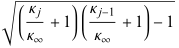 , ...,
 surrounding mutually tangent circles forming an
 -flower. Define
 |  |  |
(4)
|
 |  |  |
(5)
|
for  .
Then for
 odd,
 |
(6)
|
and for  even
 |
(7)
|
where  and
 (Mathews and Zymaris 2025).
