


A D-form is a closed piecewise developable surface constructed by joining the boundaries of two planar regions with equal perimeters, without stretching or shearing either region. The construction was introduced by Tony Wills (Sharp 2005, p. 121). Different choices of corresponding boundary points can produce different shapes from the same pair of regions.
For the smooth convex D-forms considered by Demaine and Price (2010), the two planar regions are convex sets with smooth boundaries,
and the assembled surface is piecewise  and bounds a convex body.
They proved that this convex body is the convex
hull of the seam and that neither patch has interior creases. Huang et al.
(2023) give optimization methods both for constructing a D-form from two planar
regions and for finding planar regions that produce a prescribed spatial seam.
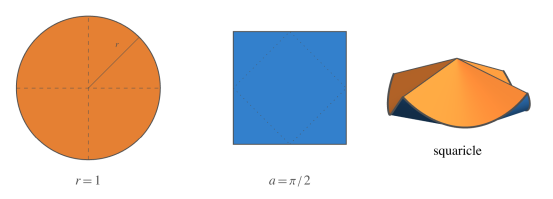
The squaricle illustrated above is a deliberately creased variant made from a disk and a square
with equal perimeters (Sharp 2005, p. 123). For
a disk of radius  , the square has side
length
 |
Folding the disk along two perpendicular diameters produces four generalized cone patches. The square forms a central planar square and four generalized cylinder patches. The creases and nonsmooth boundary distinguish this construction from the smooth convex D-forms covered by the theorem above (Demaine and Price 2010, Huang et al. 2023). The squaricle is a spatial surface, distinct from the planar squircle.

Viewed from above, the squaricle has fourfold rotational symmetry, with four radial creases meeting at its apex.
