TOPICS
Search

Cumulative Partition Function


The cumulative partition function is the partial sum
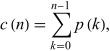
 c(n)=sum_(k=0)^(n-1)p(k),

where p(k) is the partition function and c(0)=0 (Ji 2026). For n=1, 2, ..., its values are 1, 2, 4, 7, 12, 19, 30, 45, 67, 97, ... (OEIS A000070, shifted by one place).

Ji (2026) proved that for every integer a>=1, b>=0, and m>=2, the sequence c(an+b) is not eventually constant modulo m, and consequently is not eventually periodic modulo m. In particular, both parities occur infinitely often on every arithmetic progression. This does not assert that every residue modulo m occurs.


See also

Partial Sum, Partition, Partition Function P

Explore with Wolfram|Alpha

References

Ji, K. Q. "Nonexistence of Constant Congruences for the Cumulative Partition Function." 22 Oct 2026. https://arxiv.org/abs/2610.31102.Sloane, N. J. A. Sequence A000070 in "The On-Line Encyclopedia of Integer Sequences."

Cite this as:

Weisstein, Eric W. "Cumulative Partition Function." From MathWorld--A Wolfram Resource. https://mathworld.wolfram.com/CumulativePartitionFunction.html

Subject classifications
