


The Cornu spiral is a plot in the complex plane of the points
 |
(1)
|
where  and
 are the Fresnel
integrals (Gray 1997, p. 65; von Seggern 2007, p. 210). The Cornu spiral
is also known as the clothoid or Euler's spiral. It was probably first studied by
Johann Bernoulli around 1696 (Bernoulli 1967, pp. 1084-1086). A Cornu spiral
describes diffraction from the edge of a half-plane.

The quantities  and
 are plotted above.
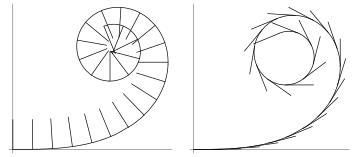
The normal vector and tangent vector plots above use the reflected convention
 , obtained by exchanging the coordinates
of
 . The slope of its tangent
vector (above right figure) is
 |
(2)
|
plotted below.

For the convention  in the first figure, the corresponding slope is
 |
(3)
|
Each slope formula applies where its denominator is nonzero.
The Cesàro equation for a Cornu spiral is  , where
 is the radius of curvature,
 is the arc
length from the origin along either branch, and
 is a scale constant.
For the normalization of the Fresnel integrals
used here,
 and
 , so
 |
(4)
|
The torsion is  where the curvature is nonzero.

Gray (1997) defines a generalization of the Cornu spiral given by parametric equations
 |  |  |
(5)
|
 |  |  |
(6)
|
 |  |  |
(7)
|
 |  |  |
(8)
|
where  is a generalized hypergeometric
function. Take real numbers
 and
 , with
 .
The arc length from  , signed curvature,
and tangential angle measured from the positive
 -axis of this
curve are
 |  |  |
(9)
|
 |  |  |
(10)
|
 |  |  |
(11)
|
The Cesàro equation is
 |
(12)
|

Dillen (1990) describes a class of "polynomial spirals" for which the curvature is a polynomial
function of the arc length. These spirals are a
further generalization of the Cornu spiral. The curves plotted above correspond to
 ,
 ,
 ,
 ,
 , and
 , respectively.
More generally, if  is a polynomial with
 and
 , a corresponding curve has
parametric equations
 |  |  |
(13)
|
 |  |  |
(14)
|
where  is the initial point and
 is the initial tangential
angle. Here
 is a signed arc length parameter increasing along the
curve, with
 at the initial point. The six polynomials
corresponding to the listed curvatures are
 |  |  |
(15)
|
 |  |  |
(16)
|
 |  |  |
(17)
|
 |  |  |
(18)
|
 |  |  |
(19)
|
 |  |  |
(20)
|
Changing  rotates the curve without changing its curvature.
Thus the constant of integration in a generating
polynomial specifies orientation rather than a different
intrinsic curve.
Clothoid segments can be joined to construct curvature-continuous splines (Walton and Meek 1990; Meek and Thomas 1991; Meek and Walton 1992).
