TOPICS
Search

Complete Homogeneous Symmetric Polynomial


A complete homogeneous symmetric polynomial h_k(x_1,...,x_n) is the sum of all monomials of total degree k in n variables, where k is a nonnegative integer and n is a positive integer:

 h_k(x_1,...,x_n)=sum_(i_1+...+i_n=k)x_1^(i_1)...x_n^(i_n),

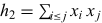
where the indices are nonnegative integers and h_0=1. For example, h_1=sum_(i)x_i and h_2=sum_(i<=j)x_ix_j. These are symmetric polynomials as well as homogeneous polynomials.

The McLeod conjecture concerns ratios of complete homogeneous symmetric polynomials (Sra 2026, p. 1).


See also

Elementary Symmetric Polynomial, Foulkes Conjecture, Homogeneous Polynomial, McLeod Conjecture, Symmetric Polynomial

Explore with Wolfram|Alpha

References

Sra, S. "A Proof of McLeod's 1959 Conjecture on Complete Homogeneous Symmetric Ratios." 5 Oct 2026. https://arxiv.org/abs/2610.07302.

Cite this as:

Weisstein, Eric W. "Complete Homogeneous Symmetric Polynomial." From MathWorld--A Wolfram Resource. https://mathworld.wolfram.com/CompleteHomogeneousSymmetricPolynomial.html

Subject classifications