

A clustered coloring assigns colors to the vertices of a graph so that each monochromatic connected component has at most a prescribed number of vertices. Unlike a proper coloring, it permits adjacent vertices to have the same color. The clustered chromatic number of a class of graphs is the least number of colors that suffices with a uniform bound on the sizes of monochromatic connected components.
Grzesik et al. (2026) proved that the class of finite simple graphs of maximum
average degree at most  has clustered
chromatic number
 , where
 is the floor function.
More specifically, for nonnegative integers
 , every graph
 satisfying
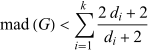 |
has an assignment of colors 1, ...,  to its vertices in which the
monochromatic connected components of color
 have at most
 vertices. This also bounds their maximum
vertex degree by
 and gives a defective coloring.
