

For positive integers  and
and  , the classical occupancy problem asks how many of
  distinguishable
boxes are occupied after
distinguishable
boxes are occupied after  distinguishable balls are placed into the boxes, with the
box choices independent and
identically distributed according to the discrete
uniform distribution (Feller 1968). It is the basic probabilistic case of the
broader occupancy problem and one case of the
twelvefold way. If
distinguishable balls are placed into the boxes, with the
box choices independent and
identically distributed according to the discrete
uniform distribution (Feller 1968). It is the basic probabilistic case of the
broader occupancy problem and one case of the
twelvefold way. If  is the number of occupied boxes, then
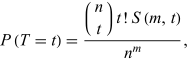 |
where  is a Stirling number of the second
kind and
is a Stirling number of the second
kind and  .
The factors choose the
.
The factors choose the  occupied boxes, form a set partition
of the
occupied boxes, form a set partition
of the  balls into
  nonempty groups, and assign those groups to the selected
boxes.
nonempty groups, and assign those groups to the selected
boxes.
The expectation value of the number of occupied boxes is
![E[T]=n[1-(1-1/n)^m],](/images/equations/ClassicalOccupancyProblem/NumberedEquation2.svg) |
where ![E[Y]](/images/equations/ClassicalOccupancyProblem/Inline11.svg) denotes the expectation value of
denotes the expectation value of  . This follows by writing
  as the sum of
  indicator functions,
one for each box. The related coupon collector's
problem asks how long it takes to occupy every box.
indicator functions,
one for each box. The related coupon collector's
problem asks how long it takes to occupy every box.
