TOPICS
Search

Broken Bamboo Problem


The broken bamboo problem is a historical right triangle problem from the Chinese mathematical work The Nine Chapters on the Mathematical Art.

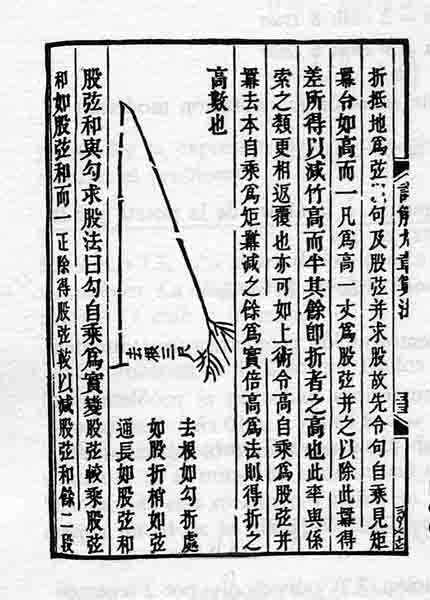
The broken bamboo problem in an 1840--1842 edition of Yang Hui's Detailed Analysis of the Mathematical Methods in the Nine Chapters.

The earliest surviving diagram of the problem is attributed to Yang Hui's 1261 Detailed Analysis of the Mathematical Methods in the Nine Chapters (Dauben 2007).

BrokenBambooProblem

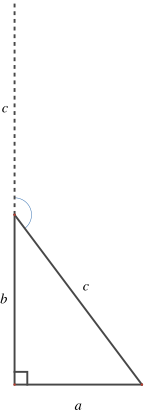
A modern schematic is shown above. A bamboo stalk of height h breaks at height b above level ground, and its tip touches the ground at distance a from the foot of the stalk. Write c=h-b for the length of the broken upper part.

The Pythagorean theorem gives

 b^2+a^2=(h-b)^2,

and therefore

 b=(h^2-a^2)/(2h).

For the traditional values h=10 and a=3, this yields b=91/20=4+11/20.


See also

Pythagorean Theorem, Right Triangle, Thabit ibn Qurra's Theorem

Explore with Wolfram|Alpha

References

Dauben, J. W. "The Nine Chapters on the Mathematical Art." In The Mathematics of Egypt, Mesopotamia, China, India, and Islam: A Sourcebook. (Ed. V. J. Katz). Princeton, NJ: Princeton University Press, pp. 284 and 287-288, 2007. The image on p. 284 is from an 1840-1842 edition held by the British Library, London and is credited to British Library Archive/Bridgeman Images.History of Mathematics Project. "The Broken Bamboo Problem." https://www.history-of-mathematics.org/artifacts/broken-bamboo-problem.Joseph, G. G. The Crest of the Peacock: Non-European Roots of Mathematics, 3rd ed. Princeton, NJ: Princeton University Press, pp. 257-258, 2011.Maor, E. The Pythagorean Theorem: A 4,000-Year History. Princeton, NJ: Princeton University Press, pp. 64-66, 2007.

Cite this as:

Weisstein, Eric W. "Broken Bamboo Problem." From MathWorld--A Wolfram Resource. https://mathworld.wolfram.com/BrokenBambooProblem.html

Subject classifications