When
is a right angle, the construction reduces to the
usual Pythagorean theorem. Thabit ibn Qurra
gave this result in a ninth-century treatise on the proof attributed to Socrates
(Sayili 1960, Maor 2007). Three manuscript witnesses of the treatise are cataloged
in Cairo, Damascus, and the Süleymaniye Manuscript Library in Istanbul (Islamic
Scientific Manuscripts Initiative).


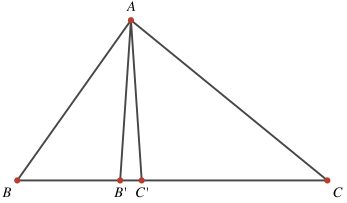
 . Choose points
  and
and  on the line
  so that
  . The resulting similar
triangles give
. The resulting similar
triangles give



 is a right angle, the construction reduces to the
usual Pythagorean theorem. Thabit ibn Qurra
gave this result in a ninth-century treatise on the proof attributed to Socrates
(Sayili 1960, Maor 2007). Three manuscript witnesses of the treatise are cataloged
in Cairo, Damascus, and the Süleymaniye Manuscript Library in Istanbul (Islamic
Scientific Manuscripts Initiative).
is a right angle, the construction reduces to the
usual Pythagorean theorem. Thabit ibn Qurra
gave this result in a ninth-century treatise on the proof attributed to Socrates
(Sayili 1960, Maor 2007). Three manuscript witnesses of the treatise are cataloged
in Cairo, Damascus, and the Süleymaniye Manuscript Library in Istanbul (Islamic
Scientific Manuscripts Initiative).
