

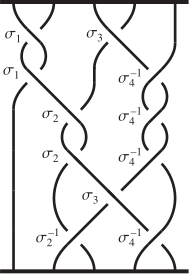
Braid theory studies braids up to isotopy. An  -strand braid
consists of
-strand braid
consists of  pairwise disjoint strands connecting fixed upper and
lower endpoints, with every strand directed downward.
Crossings in a braid diagram record which strand passes
over the other. The figure above illustrates a 5-strand braid.
pairwise disjoint strands connecting fixed upper and
lower endpoints, with every strand directed downward.
Crossings in a braid diagram record which strand passes
over the other. The figure above illustrates a 5-strand braid.
Equivalence classes of  -strand braids form the braid
group
-strand braids form the braid
group  ,
with multiplication given by stacking braids.
,
with multiplication given by stacking braids.
Braid theory connects group theory with knot theory. Closing the upper and lower endpoints of a braid produces a knot or link. Alexander's theorem states that every oriented link can be represented as the closure of a braid, while Markov's theorem characterizes when two closed braids represent equivalent links.
