

A Bose gas is a many-particle quantum model whose state vectors are symmetric under permutations of particles. For  particles on a three-dimensional torus
of side
 , a standard Hamiltonian
in units with kinetic coefficient one is
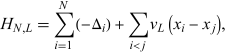 |
where  is the periodic pair potential. The
density is
 .
A hard-sphere gas instead excludes configurations with
pair distance at most
 and uses the kinetic quadratic form with zero boundary values on the excluded region. For hard spheres
this exclusion distance is also the scattering length.
For a general many-particle density operator  of trace one, the one-particle operator
is
 and has
trace
 . Its constant-orbital
fraction is
 ,
with
 . For a ground
state whose condensate occupies this orbital,
 is the condensate fraction and
 is the quantum depletion
fraction.
