

The name Boltzmann integral is used for two distinct integral constructions. In kinetic theory, the Boltzmann collision integral describes the net change in a particle distribution caused by collisions (Cercignani et al. 1994). One common form is
![Q(f,f)(v)=int_(R^3)int_(S^2)B(v-v_*,omega)[f(v^')f(v_*^')-f(v)f(v_*)]domegad^3v_*,](/images/equations/BoltzmannIntegral/NumberedEquation1.svg) |
where the two products in the integrand respectively count particles entering and leaving velocity  .
.
In linear viscoelasticity, the Boltzmann superposition integral expresses a stress or strain response as a convolution
over the loading history (Tschoegl 1989). For example, the stress  produced by a strain history
  can be written
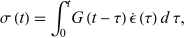 |
where  is the response function. Thus the first construction
is a collision operator on a particle-distribution function,
while the second superposes delayed material responses.
is the response function. Thus the first construction
is a collision operator on a particle-distribution function,
while the second superposes delayed material responses.
