

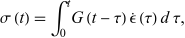
The Boltzmann superposition integral expresses the response of a linear viscoelastic material to a loading history as a convolution. If
the stress and strain histories vanish before  , the stress
  produced by a differentiable
strain history
produced by a differentiable
strain history  with
with  is
is
 |
(1)
|
where the relaxation modulus  is the stress response when a unit step
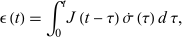
function is applied as the strain. Conversely, the strain produced by a differentiable
stress history with
is the stress response when a unit step
function is applied as the strain. Conversely, the strain produced by a differentiable
stress history with  is
is
 |
(2)
|
where the creep compliance  is the strain response when a unit step
function is applied as the stress. Thus each increment in the loading history
contributes a delayed response, and the total response is the sum
of these contributions.
is the strain response when a unit step
function is applied as the stress. Thus each increment in the loading history
contributes a delayed response, and the total response is the sum
of these contributions.
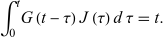
The two response functions determine one another. If  and
and  denote their Laplace transforms, then
 |
(3)
|
or equivalently,
 |
(4)
|
The latter is a Volterra integral equation of the first kind. A common mathematical admissibility condition is
that  and
and  be completely monotonic functions
(Loy and Anderssen 2014).
be completely monotonic functions
(Loy and Anderssen 2014).
