


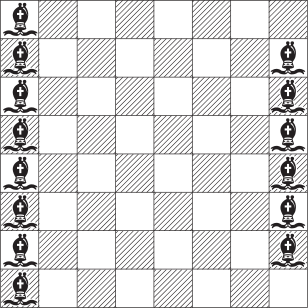
The bishops problem asks for the maximum number of bishops  that can be placed on an
 chessboard such that
no two attack each other, where
 is a positive integer.
The answer is
 and
 for
 (Dudeney 1970, Madachy 1979), giving the sequence 2, 4, 6, 8, ... (the even
numbers) for
 ,
3, .... One maximum solution for
 is illustrated above. The numbers of placements of
 indistinguishable nonattacking bishops
on a fixed
 chessboard, counting rotations
and reflections separately, are 1, 4, 26, 260, 3368,
... for
 ,
2, ... (OEIS A002465, with its empty-board
term omitted).
Let  count maximum arrangements on an
 chessboard, with rotations and reflections
identified. Then
 ,
and for
 ,
 |
(1)
|
(Dudeney 1970, p. 96; Madachy 1979, p. 45; Pickover 1995). An equivalent formula for  is
 |
(2)
|
where  is the floor function. The values
 for
 , 2, ... are 1, 1, 2, 3, 6, 10, 20, 36, .... For
 ,
 for OEIS A005418;
the one-square value is prepended.
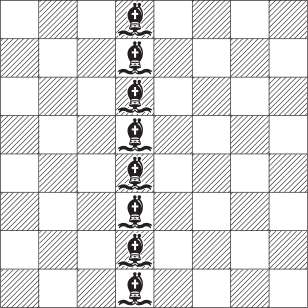
The minimum number of bishops needed to occupy or attack all squares on an  chessboard is
 (Cockayne et al. 1986). A minimum arrangement places
one bishop on each square of a central row, as illustrated above.

 Queens Problem." §C18 in