

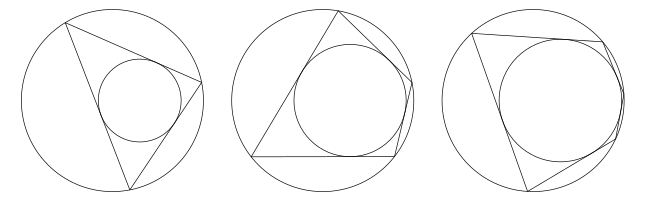
A bicentric polygon is a polygon with both a circumcircle (which touches each vertex) and an incircle (which is tangent to each side). All triangles are bicentric with
 |
(1)
|
where  is the circumradius,
 is the inradius, and
 is the separation of centers. For bicentric
quadrilaterals, a result sometimes known as Fuss's problem, the circles
satisfy
 |
(2)
|
(Dörrie 1965, Salazar 2006) or, in another form,
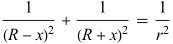 |
(3)
|
(Davis; Durége 1861; Casey 1888, pp. 109-110; Johnson 1929; Dörrie 1965).
If the circles permit successive tangents around the incircle which close the polygon for one starting point on the circumcircle, then they do so for all points on the circumcircle, a result known as Poncelet's porism.
Tran (2026) obtained further identities and invariants for the family of convex bicentric  -gons between two fixed, strictly nested,
nonconcentric circles. Let the circumcircle
have center
 and radius
 , the incircle
have center
 and radius
 , and put
 , with
 . Write
 for the vertices,
 for the point where
 touches the incircle,
 , and
 for the area, with indices modulo
 . Then
 |
(4)
|
The sums  are invariant throughout the family for every
 . More generally, every
even-degree elementary symmetric polynomial
in
 is constant, and every odd-degree one divided by
 is constant. In particular,
 is invariant. Two other invariants are
 |
(5)
|
Within this fixed-circle family, two polygons of the same area coincide or are reflections of one another in the line  . The unique maximum-area polygon has a vertex at the
point of the circumcircle farthest from
 ; the unique minimum-area polygon has a side tangent at the
point of the incircle nearest to
 . They are also the perimeter extrema, since the perimeter is
 . These are extrema within
the fixed-circle Poncelet family, not among arbitrary bicentric polygons.
There is also a complete classification of fixed points  for which
 is invariant. For
 , let
 be the center of the fixed circle tangent to the diagonals
 , and let
 be its inverse point
in the circumcircle. The complete list consists
of
 , all the
 and
 , and, when
 is even, the two limiting points
of the circle pencil (Tran 2026).
