


A Beloch fold is an origami fold that simultaneously maps two given points  and
and  onto two given lines
  and
and  , respectively. It is the sixth of Huzita's origami
axioms. For each point-line pair, a crease that performs the required reflection
is a tangent line to the parabola
having the point as its focus and the line as its directrix.
A Beloch fold is therefore a common tangent line
of two such parabolas (Hull 2011).
, respectively. It is the sixth of Huzita's origami
axioms. For each point-line pair, a crease that performs the required reflection
is a tangent line to the parabola
having the point as its focus and the line as its directrix.
A Beloch fold is therefore a common tangent line
of two such parabolas (Hull 2011).
Two parabolas can have up to three common tangents. Beloch (1936) used this operation to construct roots of general cubic equations, thereby giving origami constructions for angle trisection and cube duplication (Hull 2011).
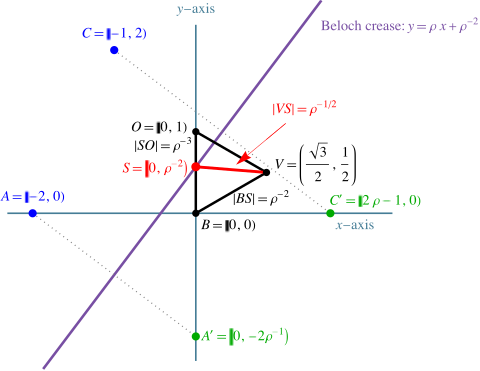
For example, a Beloch fold gives a geometric construction of the plastic constant  (Pegg 2025). On a coordinate sheet containing
the unit equilateral triangle with base endpoints
(Pegg 2025). On a coordinate sheet containing
the unit equilateral triangle with base endpoints
 and
and  and apex
  , simultaneously fold
  onto the
  -axis and
  onto the
  -axis. For a crease
  , the two reflection conditions
give
, the two reflection conditions
give  and
and  , so
, so  . The unique real root
is therefore
. The unique real root
is therefore  ,
and the crease is
,
and the crease is
 |
It intersects the triangle's base at  , giving
  ,
,  , and
, and  . In addition, the distance
from
. In addition, the distance
from  to
to  is
is  .
The reflected points are
.
The reflected points are  and
and  , respectively.

 Pegg, E. Jr. "BelochFold." Wolfram Function Repository.
May 12, 2025.
Pegg, E. Jr. "BelochFold." Wolfram Function Repository.
May 12, 2025.