


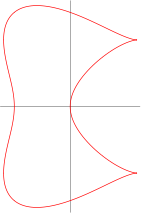
The bicuspid curve is the quartic curve given by the implicit equation
 |
(1)
|
so-named because of its resemblance to a tooth.
The bicuspid curve has cusps at  and
and  .
.
For 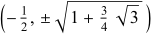 ,
the horizontal tangents are located at
,
the horizontal tangents are located at  , and the vertical
tangents at
, and the vertical
tangents at  ,
,
 , and
, and  , where
  is the positive real root of
 .
.
For  ,
a parameterization of the upper half of the
curve is
,
a parameterization of the upper half of the
curve is
 |  |  |
(2)
|
 |  |  |
(3)
|
where  ,
,
 |
(4)
|
and  is the unique real root of
  . This gives an exact elliptic
integral representation for the enclosed area
. This gives an exact elliptic
integral representation for the enclosed area
 |
(5)
|
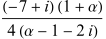
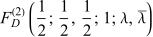
For an exact expression in terms of the Lauricella functions  and
and  ,
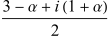
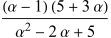
define
,
define
 |  |  |
(6)
|
 |  |  |
(7)
|
 |  |  |
(8)
|
 |  |  |
(9)
|
 |  |  |
(10)
|
 |  |  |
(11)
|
where  is the root of
  with positive imaginary
part,
with positive imaginary
part,  is the imaginary unit, an overbar denotes the complex conjugate, and
  and
and  are taken on the branch defined by their one-dimensional
Euler integrals over
are taken on the branch defined by their one-dimensional
Euler integrals over  . The area is then
 |  | ![(pia^2sqrt(-alpha-1))/2[B_0D_2+2Re[BD_3]]](/images/equations/BicuspidCurve/Inline48.svg) |
(12)
|
 |  |  |
(13)
|
(OEIS A193625; E. Weisstein, Aug. 27, 2026), where  denotes the real part. For the arc
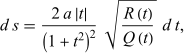
length, differentiating the parameterization
gives
denotes the real part. For the arc
length, differentiating the parameterization
gives
 |
(14)
|
where
 |
(15)
|
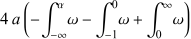
and hence the perimeter is
 |  | ![4a[int_(-infty)^alpha(|t|)/((1+t^2)^2)sqrt((R(t))/(Q(t)))dt+int_(-1)^infty(|t|)/((1+t^2)^2)sqrt((R(t))/(Q(t)))dt]](/images/equations/BicuspidCurve/Inline55.svg) |
(16)
|
 |  |  |
(17)
|
 |  |  |
(18)
|
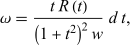
(OEIS A193626; E. Weisstein, Aug. 28, 2026), where
 |
(19)
|
and
 |
(20)
|
with  on the intervals of integration. Because the polynomial
  has degree
10 and no multiple roots, the equation defines a
hyperelliptic curve of genus
4 and the expression for
has degree
10 and no multiple roots, the equation defines a
hyperelliptic curve of genus
4 and the expression for  in terms of
  is an exact genus-4 Abelian
integral.
is an exact genus-4 Abelian
integral.
