TOPICS
Search

Base-Power Partition


A base-power partition, also called an l-ary partition, is a partition of a nonnegative integer n into powers of a fixed base l>=2, including l^0=1. If each power can occur at most k times, write b_(k,l)(n) for the number of such partitions. Its generating function is

 sum_(n=0)^inftyb_(k,l)(n)x^n=product_(j=0)^infty(1+x^(l^j)+...+x^(kl^j)).

In particular, b_(2,2)(n) is the (n+1)st term of Stern's diatomic series, indexed from a_0=0 (Calkin and Wilf 2000).

For k>=l-1, let A(k,l) be the limit superior of lnb_(k,l)(n)/lnn as n->infty. Coons (2026) asked whether A(k,l)<A(k+1,l) always holds. A counterexample from the Omega Institute is
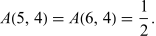
 A(5,4)=A(6,4)=1/2.

For either multiplicity limit, each representation of 4^m<=n<4^(m+1) is determined by the quotients upon division of its first m multiplicities by 4. Each quotient is 0 or 1, and the remainders are recovered successively from n, giving b_(k,4)(n)<=2^m. For n=1+4+...+4^m, every choice of binary carries between adjacent positions yields a distinct representation with multiplicities in {0,1,4,5}, attaining 2^m.


See also

Partition, Stern's Diatomic Series

Explore with Wolfram|Alpha

References

Calkin, N. and Wilf, H. S. "Recounting the Rationals." Amer. Math. Monthly 107, 360-363, 2000. https://doi.org/10.1080/00029890.2000.12005205.Coons, M. "The Calkin-Wilf Problems on l-ary Partition Functions." 5 Nov 2026. https://arxiv.org/abs/2611.08109.The Omega Institute. "Equal Adjacent Growth Exponents in Coons's Partition Question." trureturing. https://www.trureturing.org/research/coons-strict-adjacent-multiplicity-growth/.

Cite this as:

Weisstein, Eric W. "Base-Power Partition." From MathWorld--A Wolfram Resource. https://mathworld.wolfram.com/Base-PowerPartition.html

Subject classifications


