

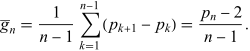
The average prime gap up to the  th prime number
  is the arithmetic mean
of the first
is the arithmetic mean
of the first  prime gaps, so
 |
(1)
|
Here, the bar denotes the average. The equality on the right follows because the sum is a telescoping sum.
Each interior prime cancels, leaving  . The prime
number theorem, in the equivalent form
. The prime
number theorem, in the equivalent form  , therefore gives
 |
(2)
|
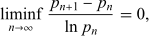
Thus the average gap grows without bound. Individual gaps fluctuate substantially around this scale. In particular, Goldston et al. (2009) proved that the infimum limit
 |
(3)
|
and the stronger result on bounded gaps between primes gives infinitely many gaps no larger than 246 (Polymath 2014). Neither result says that the average prime gap is bounded.
